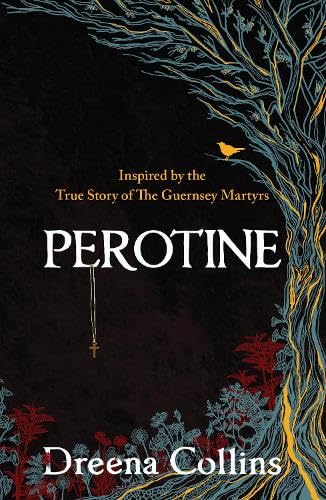
I recently met author Dreena Collins at a Jersey Festival of Words event, and it was there that I picked up a copy of her book (pictured above).
On a bleak autumn morning in 1555, Protestant Perotine wakes to find her husband packed to leave. Catholicism has returned to Guernsey, and, fearing for his life, he abandons Perotine, her sister and mother to face increasing hostility alone.
The three women endure a challenging winter of rain, isolation, and poverty – until a dramatic series of events draws unwanted attention. When a local woman asks Perotine to hide stolen goods, what begins as a trial for theft spirals into accusations of heresy.
Secluded, steadfast, and terrified, the women face their plight with fortitude and prayers. Together. But Perotine Massey holds a terrible secret. One that could bring a reprieve, or a fate worse than death.
And she’ll do anything to keep that secret safe.
https://blueormer.gg/product/perotine
To begin with, I should say that the content is based on real life events, and some of those events were horrific. Real women were brutalised and murdered.
The novelisation does not shy away from the violence, but is also measured in its approach. It is not gratuitous, and to not include the violence at all, would, I think, have done a disservice to those women.
The book is beautifully written, and despite the tragic content, I thoroughly enjoyed it. In particular, I enjoyed the descriptions of the natural world, which helped to ground the narrative, and also deepened my insight in to what life would have been like in Guernsey in 1555, a particularly wet and desperate year for the locals.
It struck me that the story remains sadly relevant in 2026. These were three women, going about their lives, not doing any harm, who had lived on the Island their whole lives, who were known to their local community, but who became an easy target for a dissatisfied population.
England and the Crown Dependencies had been through enormous upheaval, as England appointed a series of short-lived monarchs. Harvests had failed, and food scarcity had become a part of every day life. It is easy to imagine that there were some that would have believed that God had become displeased, and was making his wrath known on his subjects.
I would hope that in 2026, we would not be so quick to point to “act of God,” however we still regularly see issues where morality comes crashing against law.
It was not a moral act to burn people alive for their religious beliefs, however it was the law.
In 1963, Martin Luther King Jr. penned the following words:
One may well ask, “How can you advocate breaking some laws and obeying others?” The answer is found in the fact that there are two types of laws: There are just laws and there are unjust laws. I would be the first to advocate obeying just laws. One has not only a legal but a moral responsibility to obey just laws. Conversely, one has a moral responsibility to disobey unjust laws.
This is the reasoning that we need to bring to our everyday lives, particularly in the age of misinformation that we live in. Before you click “like” on that social media story, ask yourself: if this story makes me angry at a minority group, who does that serve?
What would it take to get you to turn against your friends, family, and neighbours?
Famine in Shakespearean England
https://famineanddearth.exeter.ac.uk/datetexts.html?date=1555
https://www.ageofinvention.xyz/p/age-of-invention-the-english-crisis
Harvest fluctuations and English economic history
Martin Luther King Jr. on Just and Unjust Laws
https://theconversation.com/refugees-and-riots-in-shakespeares-england-56386
“Those in Their Possession”: Race, Slavery, and Queen Elizabeth’s “Edicts of Expulsion”


Leave a Reply